
Search intent: Informational, with a secondary commercial investigation intent.
Readers searching for How AI Agents Work want to understand how AI agents think, make decisions, use tools, and complete tasks. Business readers also want to know why companies are adopting them and how they can improve daily work.
SEO keyword strategy
- Primary keyword: How AI Agents Work
- Secondary keywords:
- Why Businesses Are Adopting Them
- How Agents Work
- AI agents
- How AI agents function
- AI agent architecture
- AI agent workflow
- AI automation
- Autonomous AI systems
- AI agents vs chatbots
- AI agents in business
How AI Agents Work: A Complete Guide for Beginners and Businesses
How AI Agents Work depends on their ability to understand a goal, gather information, make decisions, use tools, and take action to complete a task. Unlike basic chatbots, AI agents can handle several steps without waiting for a person to guide every move.
Think of an AI agent as a digital worker. You give it a goal, and it works through the steps needed to reach that goal. It can search for information, check data, use software, and adjust its next move based on the results.
For example, a customer support agent can read a customer’s question, check an order, find the delivery status, and prepare a reply. It can do all these steps through connected tools and systems.
This ability to work across different tasks is one reason businesses are paying more attention to AI agents.
What Is an AI Agent?
An AI agent is a software system that uses artificial intelligence to complete tasks based on a given goal. It can understand instructions, collect useful information, choose actions, and use connected tools to get work done.
Most modern AI agents use a large language model (LLM) as their main reasoning engine. The model helps the agent understand requests and decide what to do next. Other parts of the system provide memory, data, tools, and rules.
For example, a normal AI chatbot may tell you how to book a hotel. An AI agent may search for hotels, compare prices, check available rooms, and prepare a booking.
The main difference is that an agent can move beyond giving information and perform actions. However, it can only do this when the required tools and permissions are available.
How AI Agents Work Step by Step
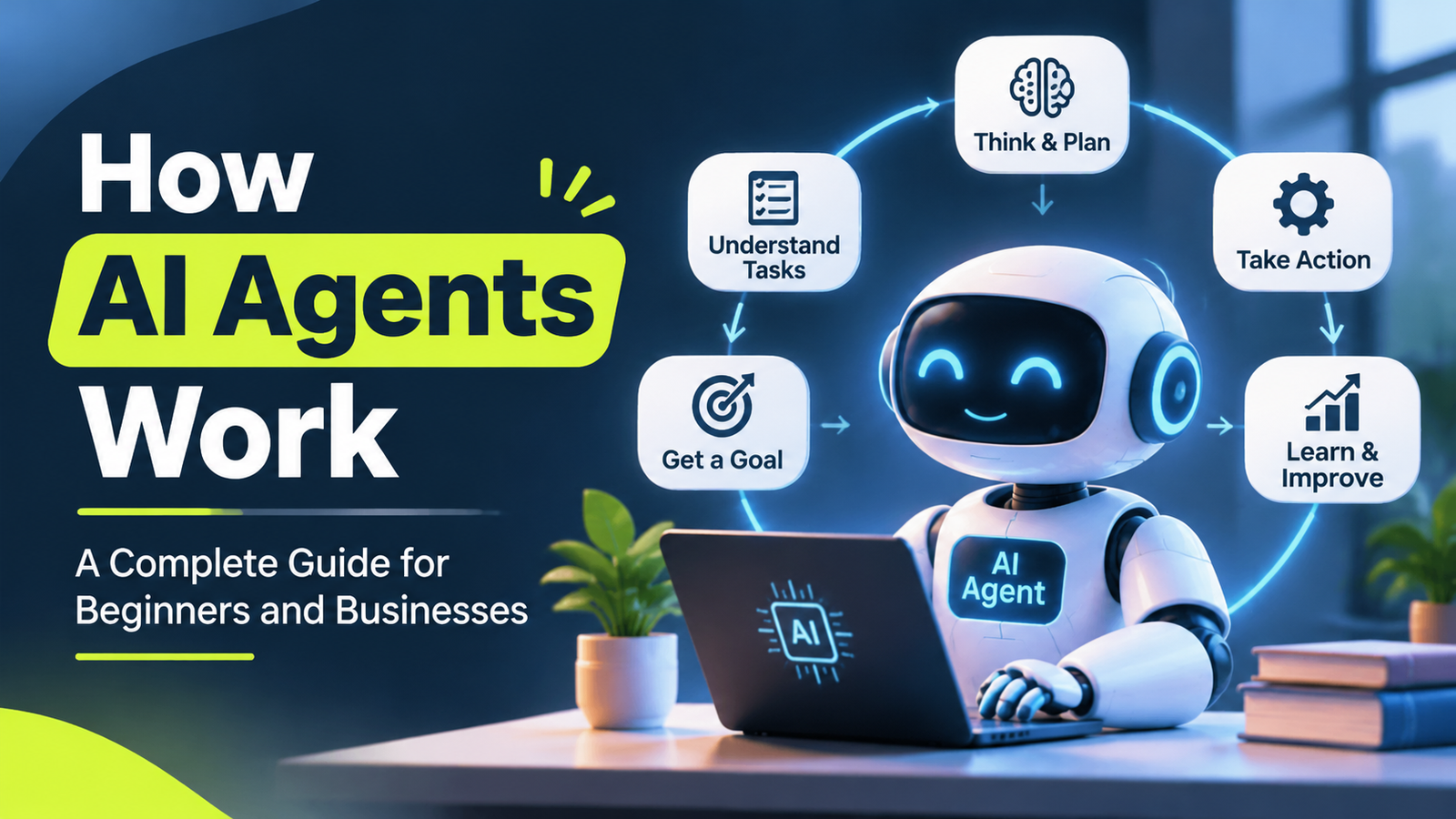
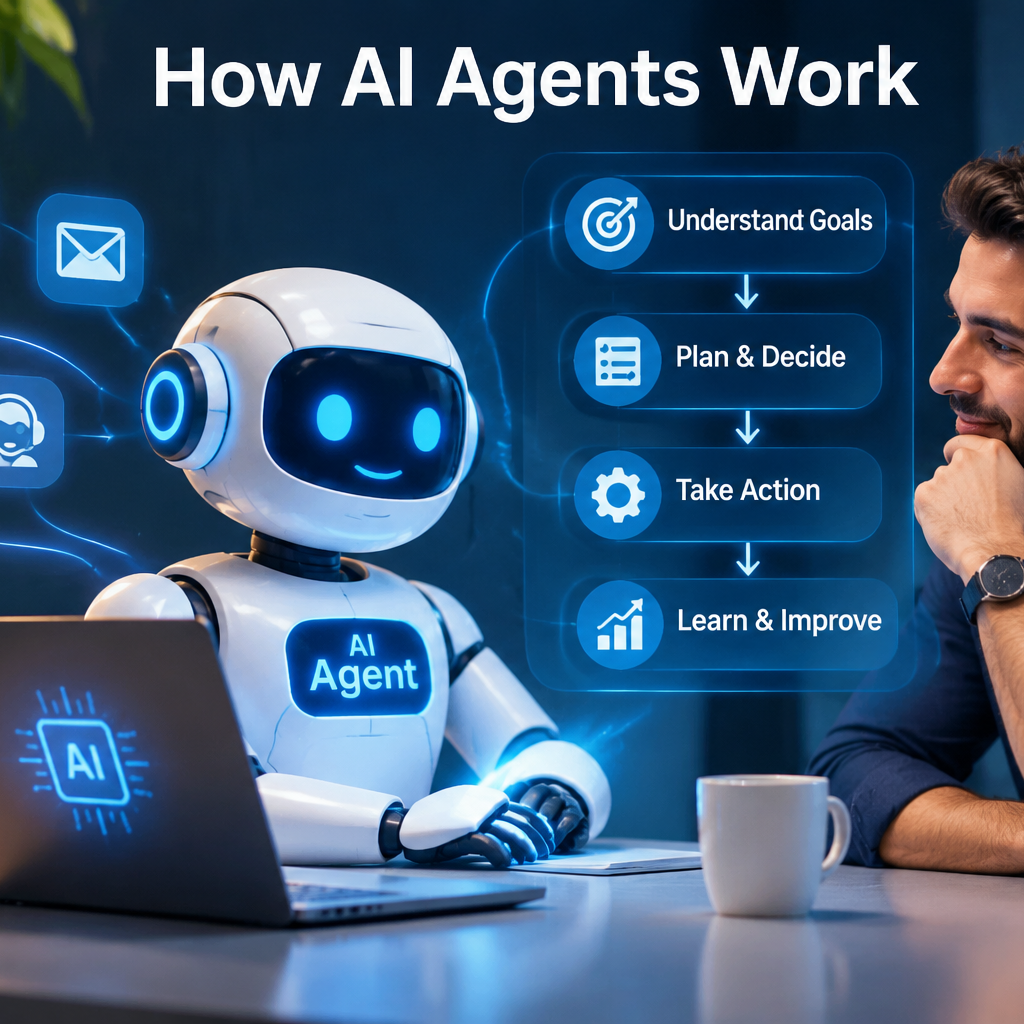
AI agents work through a repeating cycle of observation, reasoning, planning, action, and feedback. This cycle helps them handle tasks that need more than one response.
What Are AI Agents? Types, Examples, and How They Work
Here is how the process works.
1. The Agent Receives a Goal
Every task starts with an instruction or goal. A person or another system tells the agent what needs to be done.
For example:
- Find five suitable laptops for a small business.
- Check customer orders and identify delayed deliveries.
- Prepare a weekly sales report.
- Answer common customer questions.
The agent first needs to understand the request. It may also ask for more details if the goal is unclear.
2. The Agent Collects Information
Once it understands the goal, the agent gathers the information needed to complete the task.
It may collect data from:
- Company databases.
- Websites and online sources.
- Customer records.
- Business software.
- Documents and internal knowledge bases.
- APIs and connected applications.
For example, a sales agent may check a CRM system to find customer details and past purchases. This information helps it make better decisions.
3. The Agent Plans Its Next Steps
The agent uses its AI model to decide how to reach the goal. It can break a large task into smaller steps and choose the order in which to complete them.
Imagine asking an agent to prepare a sales report. It may create this plan:
- Open the sales database.
- Collect sales figures for the week.
- Compare the figures with the previous week.
- Find the best-performing products.
- Prepare a summary report.
The agent does not always follow one fixed plan. If it finds missing data, it may change its approach or ask for help.
4. The Agent Uses Tools to Take Action
This is one of the most important parts of how AI agents work.
An AI model can generate text, but an agent needs tools to interact with other systems. These tools may include APIs, databases, web browsers, email platforms, and business applications.
For example, an email agent may:
- Read an incoming message.
- Find the information needed to answer it.
- Draft a suitable reply.
- Save the draft or send it if permission allows.
The agent chooses the right tool based on the task and its available permissions.
5. The Agent Checks the Results
After taking an action, the agent checks what happened. It uses the result to decide whether the task is complete or needs another step.
For example, if an agent tries to find a customer order but receives an error, it may check the order number or try another approved search method.
This feedback loop helps the agent adjust its actions. It can continue until it reaches the goal, reaches a limit, or needs human support.
6. The Agent Delivers the Final Result
Once the task is complete, the agent shares the result with the user or connected system.
It may provide a report, update a record, prepare an email, or confirm that an action was completed.
Not every agent can complete every task on its own. Some need human approval before making important changes, sending messages, or spending money.
Main Components of an AI Agent
An AI agent is made of several parts that work together. Each part has a different role in the process.
| Component | What It Does |
|---|---|
| AI model | Understands instructions and helps make decisions. |
| Instructions | Set the agent’s goals, rules, and limits. |
| Memory | Keeps useful information and task context. |
| Knowledge base | Provides information the agent can use. |
| Tools | Let the agent interact with other systems. |
| Planning system | Breaks goals into smaller steps. |
| Feedback system | Checks results and guides the next action. |
AI Model
The AI model is the main reasoning engine. It helps the agent understand language, process information, and choose suitable actions.
Many agents use large language models. Some also use smaller or specialised models for tasks such as image recognition, speech processing, and data analysis.
Memory
Memory helps an agent keep track of useful information.
There are two common forms:
- Short-term memory: Holds information about the current task or conversation.
- Long-term memory: Stores useful information that may be needed in future tasks.
Memory helps an agent maintain context across several steps. However, not every AI agent has persistent memory.
Tools and Integrations
Tools allow agents to do work outside the AI model itself.
For example, an agent may use a calendar tool to check meetings or a CRM tool to update customer records. APIs help these systems share information.
Planning and Decision-Making
Planning helps the agent decide what to do first, what comes next, and which tools it needs.
This is useful when a task has several steps or when the next action depends on new information.
Why Businesses Are Adopting Them
Businesses are adopting AI agents because they can help manage repetitive work, connect different systems, and complete tasks with less manual effort.
Traditional automation works well when every step is known in advance. But many business tasks involve changing information, unclear requests, and unexpected problems.
AI agents can handle some of this complexity by choosing actions based on the information they receive.
Here are some key reasons behind their adoption.
1. Less Manual Work
Many teams spend hours on tasks such as checking records, sorting messages, preparing reports, and updating systems.
AI agents can handle parts of these tasks. This gives employees more time for work that needs human judgment and attention.
2. Faster Business Processes
An agent can collect information and perform several connected actions in one workflow.
For example, a sales agent may check a new lead, review its details, and add the information to a CRM. This can reduce delays between different steps.
3. Better Customer Support
AI agents can help customer support teams answer common questions and find order information.
They can also direct complex issues to a human worker. This allows support teams to focus on cases that need personal attention.
4. Improved Use of Business Data
Businesses often keep information in different systems. AI agents can connect to approved data sources and bring useful details together.
For example, a finance agent may collect sales data, compare expenses, and prepare a summary. A human can then review the findings before making a decision.
5. Support for Growing Businesses
As a business grows, the number of customer requests and daily tasks often increases.
AI agents can help manage some of this extra work. They may support larger workflows without requiring every step to be handled manually.
However, businesses still need to consider software costs, data quality, security, and human oversight.
How Businesses Use AI Agents in Different Industries
AI agents can support many types of work. Their value depends on the task, the available data, and the systems they can access.
Generative AI in Customer Service: How Intelligent Agents Redefine Support and Empathy
Fill Your Sales Pipeline with Our AI Lead Generation Stack | AIapps
NHS Copilot Pilot: 43 Minutes Saved Per User Daily with Microsoft 365 Copilot | Windows Forum
11
Customer Service
Customer service agents can:
- Answer common customer questions.
- Check order and delivery information.
- Find details in company policies.
- Create support tickets.
- Send complex cases to human staff.
For example, a customer may ask where an order is. The agent can check the order system and provide the latest available status.
Marketing and Sales
Marketing and sales teams can use AI agents to:
- Research potential customers.
- Organise lead information.
- Prepare campaign reports.
- Draft follow-up messages.
- Review customer activity.
A sales agent may check a new lead’s details and suggest the next step. A salesperson can review the suggestion before contacting the lead.
Healthcare Administration
Healthcare organisations may use agents for administrative tasks, such as:
- Organising appointment requests.
- Sorting documents.
- Helping staff find approved policy information.
- Managing routine administrative queries.
Sensitive clinical decisions still require qualified healthcare professionals. Access to patient information must also follow relevant privacy and security rules.
Finance and Accounting
Finance teams may use agents to:
- Sort invoices.
- Check transaction records.
- Prepare expense summaries.
- Flag unusual entries for review.
- Organise financial documents.
An agent can help find possible errors, but a qualified person should review important financial decisions.
Supply Chain and Logistics
AI agents can support supply chain teams by:
- Checking stock levels.
- Monitoring delivery updates.
- Finding possible delays.
- Comparing supplier information.
- Preparing reports for managers.
For example, an agent may detect a delivery delay and alert the operations team. It may also suggest another supplier if the right data and tools are available.
Types of AI Agents
Not all AI agents work in the same way. Some follow simple rules, while others can plan and manage more complex tasks.
| Type | How It Works | Example |
|---|---|---|
| Simple reflex agent | Acts on the current input using fixed rules. | A system that turns on an alert when a limit is reached. |
| Model-based agent | Uses an internal view of the environment. | A robot that tracks nearby objects. |
| Goal-based agent | Chooses actions that help reach a goal. | An agent that plans a delivery route. |
| Utility-based agent | Compares options based on their value or cost. | A system that selects a cost-effective route. |
| Learning agent | Uses feedback to improve its future performance. | A system that improves recommendations over time. |
Modern AI agents may combine several of these approaches. For example, a business agent can use an AI model to plan tasks while following fixed rules for security and approval.
AI Agents vs Traditional Chatbots
AI agents and chatbots can both communicate with people. However, they do not always perform the same role.
| Feature | Traditional Chatbot | AI Agent |
|---|---|---|
| Main purpose | Answers questions | Works toward a goal |
| Task handling | Often handles single interactions | Can handle multiple steps |
| Tool use | May have limited integrations | Can use connected tools |
| Planning | Usually follows set flows | Can create or adjust plans |
| Memory | Often limited | May use short- and long-term memory |
| Actions | Usually provides information | Can perform permitted actions |
| Human support | May pass queries to staff | May request approval or escalate tasks |
For example, a basic chatbot may tell a customer how to return a product. An AI agent may find the order, check the return policy, and prepare a return request.
The difference is not always clear-cut. Modern chatbots can also use tools, and some AI agents work within strict workflows.
AI Agents vs AI Automation
AI automation and AI agents are related, but they are not the same.
Traditional automation follows steps that people define in advance. An AI agent can choose its next step based on the goal and the information it receives.
| Feature | Traditional Automation | AI Agents |
|---|---|---|
| Process | Follows fixed rules | Can adapt its steps |
| Decisions | Uses predefined conditions | Uses AI-based reasoning |
| Flexibility | Best for predictable tasks | Can handle some changing situations |
| Tools | Runs set integrations | Can select from available tools |
| Best use | Repeated, stable processes | Multi-step tasks with changing inputs |
For example, a traditional system may send an email whenever an order is marked as shipped. An AI agent may check an order, review a delivery issue, find the relevant policy, and prepare a suitable customer response.
The important point: AI agents do not replace all traditional automation. Fixed workflows are often faster, cheaper, and easier to control for simple tasks. Agents are more useful when a process needs flexible decisions.
Benefits and Limitations of AI Agents
AI agents can make business processes easier, but they also come with risks. Understanding both sides helps businesses decide where to use them.
Key Benefits
- Save time: Handle repetitive tasks with less manual work.
- Improve efficiency: Complete several connected steps in one workflow.
- Handle large workloads: Support teams as task volumes increase.
- Use different tools: Connect information across approved business systems.
- Adapt to new information: Change a plan when task conditions change.
- Support employees: Give workers more time for complex tasks.
Key Limitations
- Incorrect results: An agent may misunderstand a request or use incorrect information.
- Security risks: Poor access controls can expose sensitive business data.
- Unexpected actions: An agent may take the wrong action if its instructions are unclear.
- Setup costs: Building and maintaining agents can require technical skills and resources.
- Limited judgment: Agents cannot replace human expertise in every situation.
- Monitoring needs: Businesses must check performance and review important actions.
How to Use AI Agents Safely
Businesses should follow a few basic rules when deploying AI agents:
- Give each agent a clear goal and limited responsibilities.
- Connect only the tools and data it needs.
- Require human approval for high-impact actions.
- Keep records of important actions and decisions.
- Test the agent with different situations before launch.
- Review its results and update its instructions when needed.
These controls help reduce errors and keep business processes under human oversight. Microsoft’s adoption guidance also highlights planning, security, governance, building, and ongoing management as key parts of responsible deployment. Microsoft Learn+1
How to Start Using AI Agents in Your Business
You do not need to automate your entire business at once. Start with one task that takes time and follows a clear process.
Here is a simple approach.
Step 1: Find a Repetitive Task
Look for work that employees do again and again. This could include sorting emails, checking orders, preparing reports, or answering common questions.
Step 2: Define the Goal
Write down what you want the agent to achieve.
For example, the goal could be to collect customer order details and prepare a response about delivery status.
Step 3: Choose the Right Tools
Decide which systems the agent needs to access. These may include a CRM, email platform, database, or inventory system.
Step 4: Set Rules and Permissions
Define what the agent can and cannot do. For example, it may prepare a refund request but need human approval before processing the refund.
Step 5: Test the Workflow
Test the agent with normal requests, missing information, unusual cases, and system errors.
Check whether it follows the right steps and produces reliable results.
Step 6: Measure Performance
Track useful measures such as:
- Time saved per task.
- Error rate.
- Number of tasks completed.
- Human intervention rate.
- Cost per completed task.
- Customer satisfaction.
These measures help you decide whether the agent is delivering real value.
What Is the Future of AI Agents?
AI agents are moving beyond simple question-and-answer tasks. They are being designed to work across business applications, manage longer workflows, and coordinate with other agents.
One important development is the use of multi-agent systems. In these systems, several specialised agents work together to complete a larger task.
For example, an online store may use:
- A research agent to collect product information.
- A sales agent to review customer needs.
- An inventory agent to check stock.
- A support agent to handle customer questions.
A coordinating system can manage the work between these agents. Each one handles a specific part of the process.
However, more agents do not always mean better results. Businesses need clear responsibilities, secure data access, and ways to check each agent’s work. AWS+2
Frequently Asked Questions
1. How do AI agents work in simple words?
AI agents receive a goal, collect useful information, make a plan, and take actions using connected tools. They check the results and repeat the process until the task is complete or they need human help.
2. Do AI agents need human supervision?
Yes, especially when they handle sensitive data or important business actions. Humans should set their limits, check their performance, and approve high-impact decisions.
3. What is the difference between AI agents and generative AI?
Generative AI creates content such as text, images, and code. AI agents use AI models along with tools, memory, and planning to complete tasks. An agent may use generative AI as its reasoning engine.
4. Can AI agents work without the internet?
Yes, some AI agents can run on local computers or private networks. However, their capabilities depend on the models, data, and tools available to them. Agents that need online services require an internet connection.
5. Why are businesses adopting AI agents?
Businesses are adopting AI agents to reduce repetitive work, improve workflows, support customers, and connect different software systems. They can also help employees spend more time on important tasks.
Conclusion
AI agents are changing how software handles everyday tasks. They do more than respond to questions. They can understand goals, plan steps, use tools, and check results.
For businesses, the biggest opportunity is not to automate everything. It is to find tasks where an agent can save time, reduce manual effort, and support better decisions.
Start with a small workflow, set clear limits, and measure the results. A well-designed AI agent should make work easier while keeping people in control.